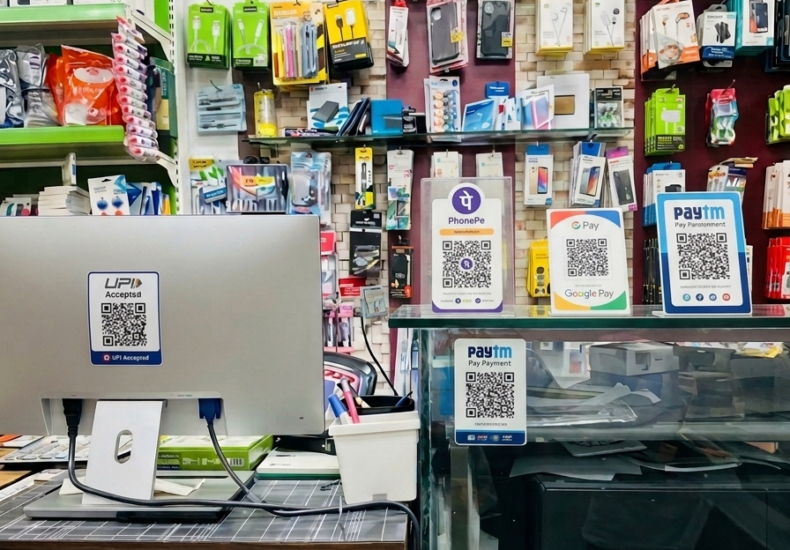
UPI at a Turning Point — The ₹2,000 Question
A new fee on high-value payments could decide whether India stays cashless or quietly slides back to cash.
Why UPI Matters
UPI is the world’s biggest real-time payment system. It handles nearly 49% of all real-time digital payment transactions worldwide. It is India’s most successful government venture of the present decade, anchoring India’s Digital Economy.
It is simple, instant and free, a system that has become an integral part of everyday life across India, from bustling cities to the smallest villages. Over the years, UPI hasn’t just been a way to pay. It has become synonymous with how Indians pay.
But UPI now stands at a turning point that could define the next chapter of its journey — one that could make it, or break it.
On September 15, 2026, the Department of Financial Services, under the Ministry of Finance, issued a notification regarding the Merchant Discount Rate (MDR) on UPI transactions. Introduced under the Payment and Settlement Systems Act, 2007, the notification specifies that a 0.4% MDR will apply to Person-to-Merchant (P2M) transactions above ₹2,000.
The government clarified that MDR is neither a tax nor a charge collected by the Government or NPCI. It is distributed among payment ecosystem participants, including banks and payment application providers, to support the operation and continued expansion of the UPI ecosystem.
What’s Actually Changing on October 15
What Will Remain Free
All Person-to-Person Transactions: All person-to-person (P2P) UPI transactions (accounting for 71% of the total transaction value) will remain completely free, irrespective of the amount transferred.
Merchant Payments Up to ₹2,000: All person-to-merchant (P2M) transactions up to ₹2,000 will remain free of MDR.
Payments Received by Small Merchants: Small merchants including street vendors receiving up to ₹1 lakh per month through UPI QR codes under the Person-to-Person-Merchant (P2PM) category will continue to enjoy zero MDR on all transactions.
What Will Attract MDR
Merchant Transactions Above ₹2,000: A nominal MDR of 0.4% will apply only to P2M transactions above ₹2,000. The MDR will be shared among payment ecosystem participants, including banks, payment service providers and UPI application providers. For transactions of ₹75,000 and above, the MDR will be capped at ₹300 per transaction.
Transactions in Essential Sectors: Transactions above ₹2,000 in essential and thin-margin sectors, including railways, telecommunications, insurance, fuel and agricultural inputs, will attract a flat MDR of ₹5 per transaction.
Capital Market Transactions: Payments relating to mutual funds, securities, stockbrokers and dealers will attract an MDR of 0.02%, capped at ₹300 per transaction.
Banks have been advised to ensure that merchants do not pass MDR charges on to customers. UPI application providers are expressly prohibited from imposing platform fees or hidden charges. Whether that’s actually enforced on the ground is a different question .
Small Slice, Big Money: The Numbers Behind the Fee
The government says Most Merchant Transactions Will Remain Unaffected.
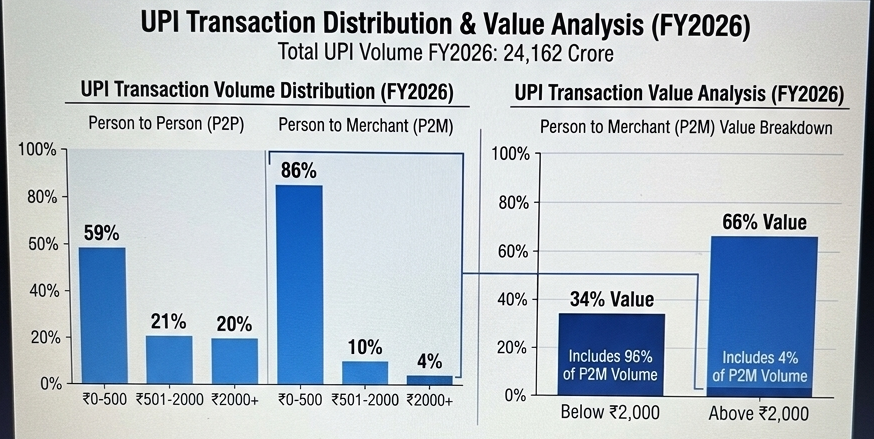
Data analysis indicates that MDR will apply to only about 4% of merchant transactions, meaning that approximately 96% of merchant transactions will remain unaffected,
While the new Merchant Discount Rate (MDR) on UPI applies to only 4% of the total transaction volume, these high-ticket transactions account for nearly 66% of the total transaction value.
UPI transactions can be understood in two categories: P2P (person-to-person) and P2M (person-to-merchant).
Overall, P2M transactions make up 63% of UPI transaction volume but only 29% of its value, while P2P accounts for 37% of volume but 71% of value.
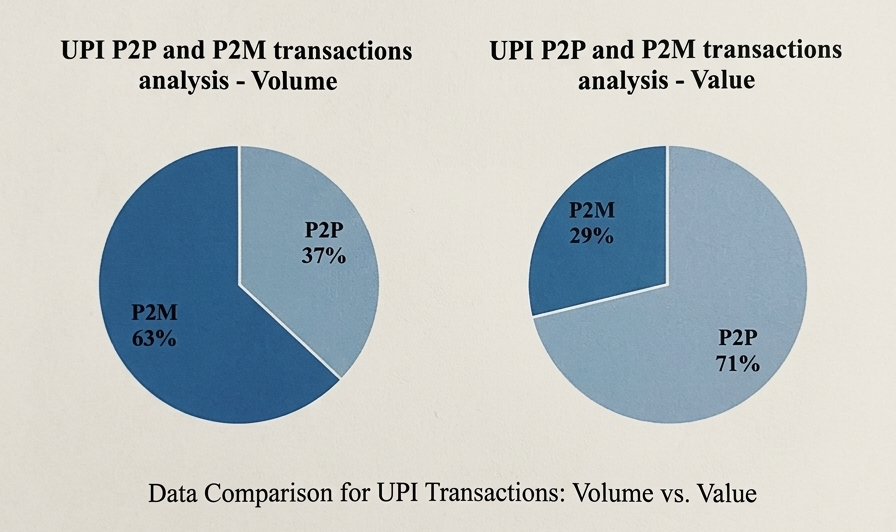
Within P2M transactions, 96% are below ₹2,000, representing everyday purchases and about 34% of P2M value, while only 4% are above ₹2,000 but account for nearly 66% of P2M value. Therefore, the proposed 0.4% MDR applies only to this 4% of high-value P2M transactions above ₹2,000, leaving the vast majority of everyday low-value UPI payments and neighbourhood merchants unaffected.
Industry estimates indicate that maintaining UPI payment operations costs around ~₹20,000 crore annually. The government argues that relying solely on fiscal budget allocations creates funding uncertainty and limits long-term technology investments by banks and fintech. Transitioning to a commercial, threshold-based model provides reliable capital for continuous technological innovation.
A Familiar Playbook
What the government is trying to do with the new UPI framework is nothing new. Many businesses in India have used it before.
First, launch the product or service for free, or at a very low discounted price. Then, scale it to the masses, so almost everyone starts using it and people eventually become habitual to it. Let it quietly become part of their daily routine. Once that habit is unshakeable and going back feels harder than staying, companies start charging for it. Economists have names for the pieces of this — penetration pricing, the freemium model, the loss leader strategy, etc.
The Indian Consumer’s Mindset
To really understand where this could go, we have to understand the Indian consumer mindset. India at its core is an extremely price-sensitive market, and despite years of digital push, the old cash mindset never fully went away — it just went quiet. There’s also a strong “free service” mindset: once something is free, people expect it to stay free, and any hint of a fee — even one they don’t technically have to pay — can trigger resistance. Add to this a section of shopkeepers who may already be looking for a reason to avoid UPI and go back to cash, and even a small, indirect cost has the potential to shift behaviour. In a market this price-sensitive, it doesn’t take much, even the slightest increase in what people end up paying— to send old cash habits back in.
The UPI Picture Government is Missing
The government’s argument that UPI infrastructure costs a lot of money (approx ₹20,000 crore per year ) is valid. But it’s worth mentioning the cost-benefit of UPI to the government itself.
UPI replaced a cash-heavy system. In reality, UPI has probably saved the government far more than it costs to run. The government talks about the visible cost of maintaining UPI, but says very little about the much bigger, harder-to-see value it has created.
By moving millions of cash-oriented transactions online, UPI helped reduce tax evasion, shrink the black money economy and pull a large part of the economy into the formal system. It is right now preventing a lot of money misuse and fraud in the government’s Direct Benefit Transfer (DBT) payouts. Its digital trail has pulled a lot of previously invisible money into the open, money the government now actually taxes. UPI makes people spend more compared to cash. This increased flow of spending boosts consumption, supports businesses, and contributes to higher economic activity and government revenue.
So why risk slowing down years of progress and reopening the door to exactly the kind of untraceable, undocumented economy UPI was built to close?
The fiscal subsidy on maintenance of UPI infrastructure costs the government around ₹20,000 crore/year, but the government spends heavily elsewhere without equivalent public justification, so why is this specific cost now being pushed onto the ecosystem rather than absorbed?
The Real Risk
Some merchants may quietly nudge customers back toward cash by using tactics like a ‘cash discount’ , a ‘UPI not working’ excuse etc.
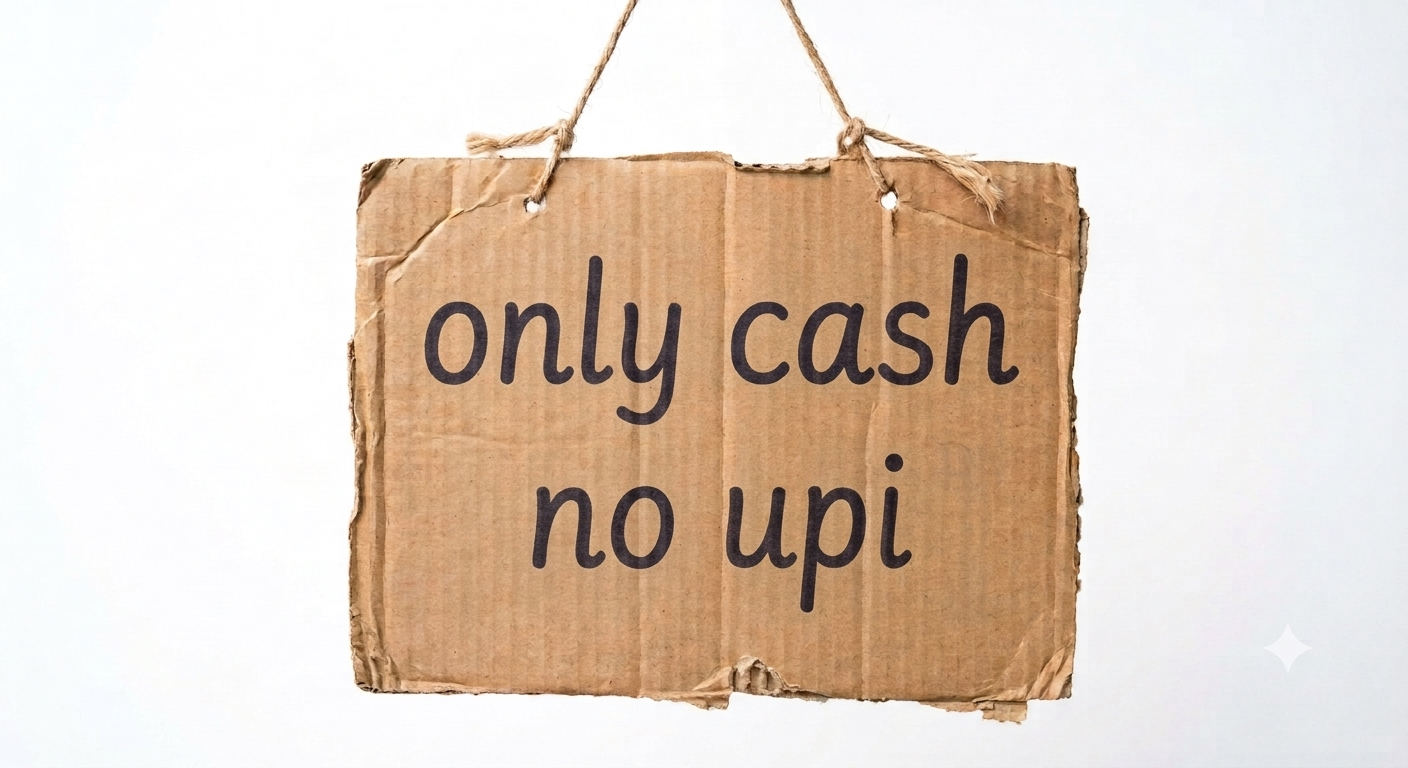
The issue for people is that this cost will trickle down to consumers, which is an extremely common practice. Shopkeepers in India will find a way to transfer this additional cost onto consumers or will use this as an excuse to stop accepting digital payments through UPI and shift back to cash.
The irony is, a policy meant to sustain UPI’s growth could, at the margins, push transactions back into the informal cash economy, which cuts against the government’s own “digital India” narrative.
Who Blinks First?
The real result will be what people experience on the ground, not what is written on paper.
From October 15, let’s see who blinks first — merchants, consumers, or the government.
Leave a Reply